
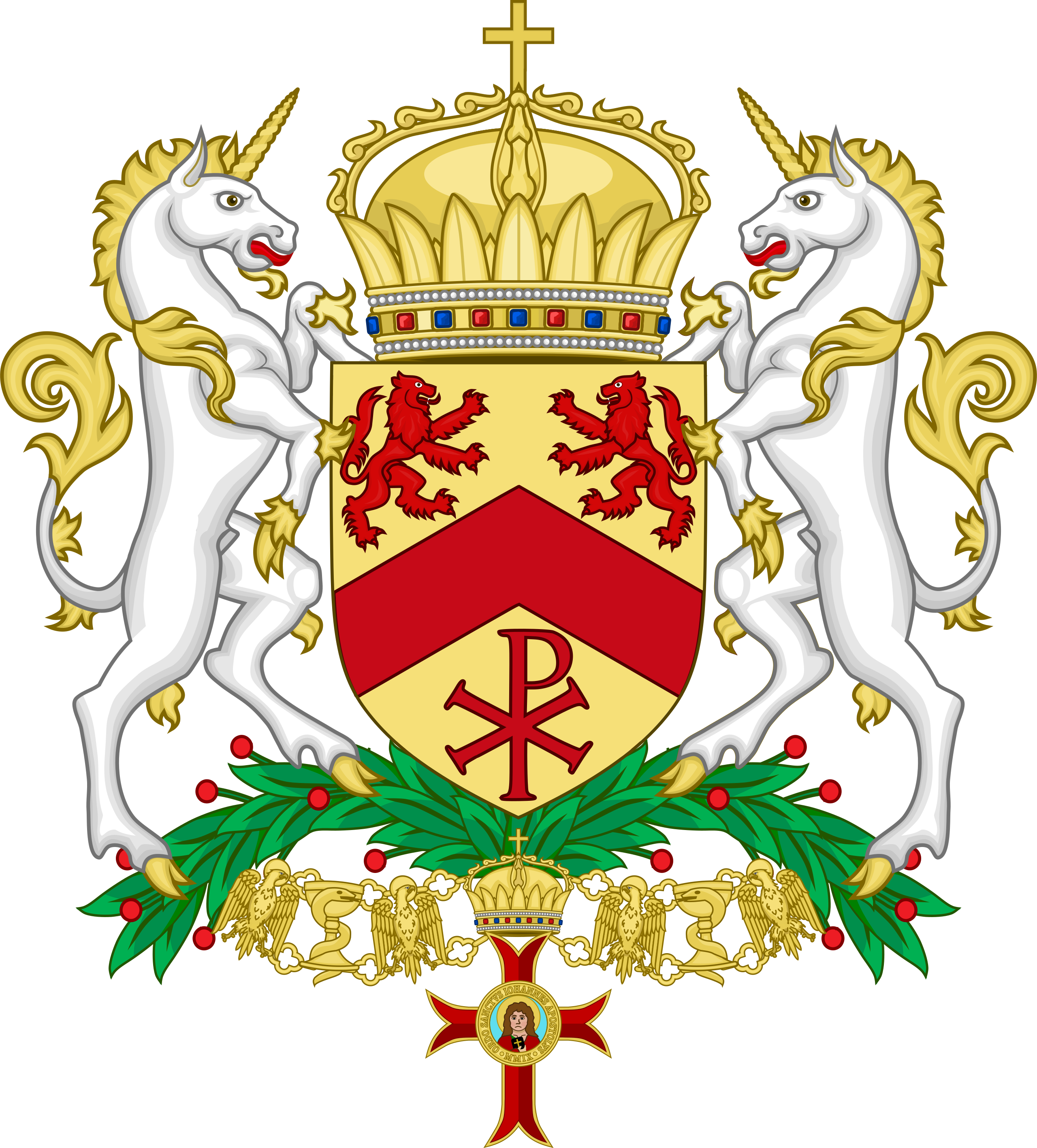
Austenasia was founded on 20 September 2008 when a family of four declared their south London home independent from the United Kingdom as the Empire of Austenasia, under the leadership of the newly-proclaimed Emperor Terry I and his son Crown Prince Jonathan.
The Empire grew tentatively and locally at first, with another house in the same town claimed in 2009 and nearby vassal kingdoms founded in 2010. A civil war broke out earlier that year between the two houses in Austenasia over a disputed succession following the abdication of Terry I, an issue which was settled by a referendum. Terry I was succeeded by Esmond III, who was in turn succeeded by Declan I.
During the reigns of Esmond III and Declan I (which overlapped by some months, with a brief period of co-monarchy), Austenasia’s unique culture began to take shape, taking inspiration from Roman and Byzantine influences. The institution of Consuls was revived, and the Austenasian Throne began to claim succession from Rome.
In 2013, Crown Prince Jonathan – son of the founding Emperor Terry I – finally ascended to the Throne as Emperor Jonathan I. This saw the start of a period of rapid growth, seeing Austenasia expand internationally with houses and properties claimed across the world, as well as the official recognition of Christianity as the Empire’s state religion in 2017. In 2018, an amendment to the Constitution officially claimed Austenasia to be a continuation of the Roman Empire, reflecting the development of the Imperium doctrine, as well as creating the Austenasian Senate.
Jonathan I abdicated in September 2024 after a long reign of eleven and a half years, and was succeeded by the Emperor Aggelos I. After a year-long reign which faced several challenges, including an unsuccessful coup attempt in June, Aggelos I abdicated on 30 September 2025, and was succeeded by the incumbent Emperor Alexander VI.
A more detailed history of the Empire of Austenasia is forthcoming.
 Empire of Austenasia